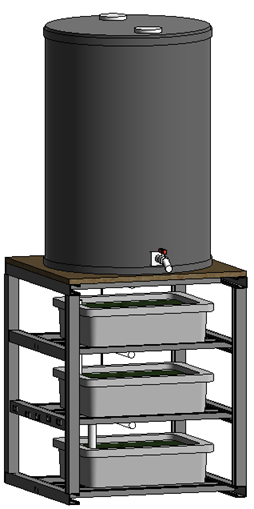
Duckweed Module

What is it?

The Duckweed Module is an extension of the water-based food web in the Food Shed. It transforms extra nutrients from the Aquaponics Module into a rich green and nutritious fish feed – Duckweed!

Duckweeds are the tiniest flowering plants known, and the fastest-growing plant known. They are also, strangely enough, related to the enormous and enigmatic Stinking Corpse Lily. Most people know Duckweeds as conspicuous denizens of ponds, ditches and slow rivers where they form large floating mats.

The fast growth rate of Duckweed species comes with a very high protein content (up to half of their weight). So there is no surprise that the small plants form an important food source in ponds and, more recently, aquaculture where it enhances the growth of fish. Duckweed is similarly gaining a reputation as a super-food for humans as “water lentils”, though it has long been a staple in Southeast Asian cultures and is not raised for human consumption in the Shed.

How does it work?

Duckweeds are opportunistic and explosive growers, rapidly converting pulses of nutrients in their environment into a lush aquatic salad. They do this by growing vegetatively, splitting one mother frond in multiple daughters. The property of rapid growth in the presence of nutrients has long drawn the attention of ecological engineers, who have studied the use of duckweed in treating sewage wastewater and developing sustainable animal feeds.

In the Shed, three tiers of duckweed grow under LED light fueled by the ammonia, nitrate and other nutrients dissolved in water added from the fish tanks.

Periodic harvesting of the duckweed mats provides a nutritious boost for the fish, though it does not entirely replace rations of commercial fish feed. This cycle is a closed loop operating between the aquaponics system and the Duckweed Module, much like fish and other animals waste spur the growth of water plants in natural ecosystems.

Why is it important?

As another example of closing loops in the Shed, the Duckweed Module highlights a path to growing food more efficiently from capitalizing on waste streams. Duckweeds in particular have immense potential for meeting the protein needs of humans while using fewer resources. Moreover, Duckweed species are widely distributed and so are native to many jurisdictions including Canada. Urban agriculturalists have taken notice, and the lowly plant is likely to play a large role in climate-smart and sustainable agriculture in the future.

What Sustainable Development Goals (SDG) are met?

The Shed’s Duckweed Module contributes to Sustainable Development Goals of Quality Education (SDG 4) by fostering skills and knowledge for sustainable agriculture.

The Shed’s Duckweed Module contributes to Sustainable Development Goals of Industry, Innovation & Infrastructure (SDG 9) by developing closed-loop technologies.

The Shed’s Duckweed Module contributes to UN Sustainable Development Goals of Responsible Consumption & Production (SDG 12) by reducing waste.

What can you do?

Visit and study a pond in your neighbourhood to find Duckweed and understand its role in aquatic ecosystems.

Learn more about how the Shed’s many closed loop design features and technologies with this downloadable lesson plan example which can be done at the Food Shed.

Read more about the natural history and applications of Duckweeds through the following unaffiliated links: